


How do you stimulate the G-spot? First, throw out everything you’ve been told. The magic button. The five positions “that work every time”. The guy who “makes” you come the way you’d start a car. Your G-spot isn’t a secret code for someone else to crack. It’s a part of you that swells, warms up and throbs when you let it come. And guess what: you’re the one holding the key. Right at your fingertips.
Does the G-spot really exist?
Yes and no. There’s no tiny isolated button, but the sensation is very real. No one has ever found a “spot” even by opening up a body. What many of us do feel, on the front wall of the vagina, is a place that sends us flying. And it isn’t magic: it’s the clitoris.
The name comes from a German gynecologist, Ernst Gräfenberg, who was already describing a sensitive area on that wall in 1950. Thirty years later, sexologists stuck the letter G on it, and marketing did the rest. That’s how generations of women ended up looking for a switch.
Except. When you sort through the research (a systematic review published in 2021 in Sexual Medicine screened 31 studies), you find that 62.9% of the women surveyed do describe a more sensitive place inside the vagina. But not in the same place, not the same size, not the same for everyone.
(spoiler) It’s the word “spot” that lies. Not your pleasure.
Researchers eventually gave it a far more honest name: the clitourethrovaginal complex. A mouthful for a very simple idea. It’s a crossroads. A place where everything touches, which varies from one woman to the next and even from one night to the next. You can’t order it around. You warm it up.
Where is the G-spot, and why is it all about the clitoris?

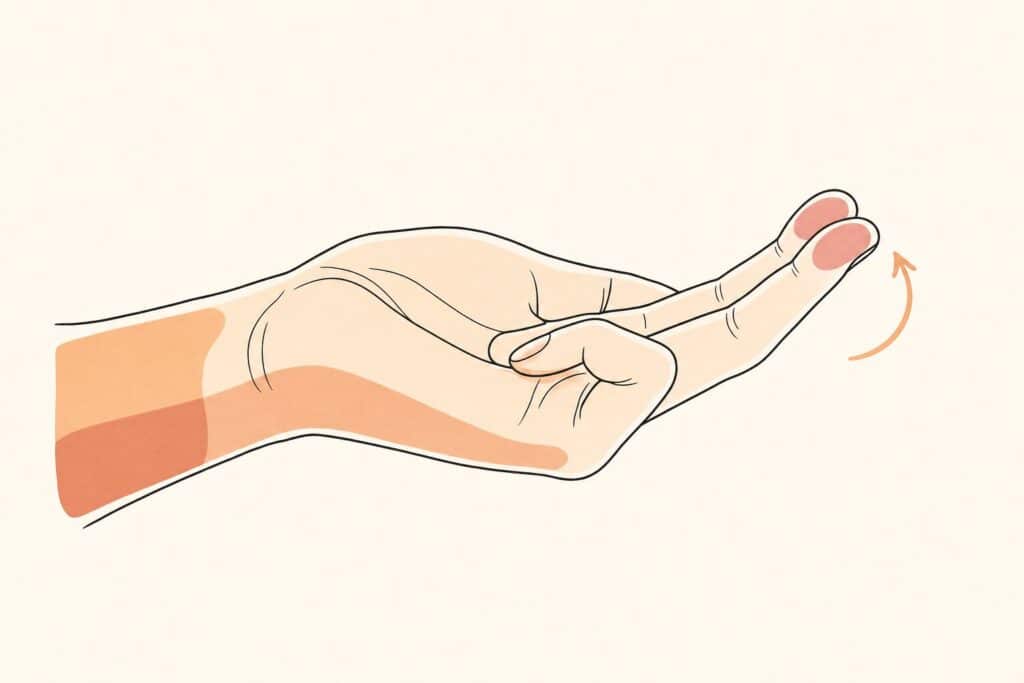
The G-spot is on the front wall of your vagina, on the belly side, one or two knuckles from the entrance. Slide a finger in, curl it toward your navel, as if you were beckoning someone over. There. You’re there.
You’ll read distances down to the centimeter everywhere. Forget the ruler. Your pussy isn’t flat-pack furniture with an instruction sheet.
Now, the real secret. Your clitoris isn’t just the little button under the hood. That’s the cherry. The whole cake is inside: legs and bulbs that wrap around your vagina and fill with blood when you get aroused. Yes, your clit gets hard. Like a cock, only more discreet and smarter.
A French gynecologist, Odile Buisson, and the urologist Pierre Foldès actually filmed a couple on ultrasound in the middle of sex (imagine the mood in that exam room). What they saw: during penetration, the root of the clitoris gets pressed against the front wall of the vagina. Your G-spot may simply be that. Your clit, caressed from the inside.
So the “vaginal” orgasm versus the “clitoral” orgasm, that great contest we’ve been sold for a century? Often, it’s the same organ. Reached through two different doors.
What is clitoral arousal?
Clitoral arousal is desire rising through your whole clitoris, not just the little glans you can see. Because yes, the clit is an iceberg: its roots and bulbs dive inside and wrap around your vagina.
When desire rises, blood rushes through this whole network. In practice, you can feel it: your vulva warms up and swells, you get wet, the glans peeks out from its hood, and your lower belly grows heavy, almost impatient. Your clit gets hard, inside and out.
And that’s exactly where the G-spot comes into play. As long as you’re “cold”, pressing on the front wall means pressing on not much at all. Once the inner clit has swelled, it presses up against that wall: the area becomes thicker, easier to find and much more responsive. That’s why all the good advice starts with the same instruction, not very sexy on paper but devastating in bed: take your time.
What does G-spot stimulation feel like?

It doesn’t feel like your outer clit. It’s duller, wider, deeper, and it builds slowly. No spark. More like a warmth spreading through your lower belly, and the urge to push your hips against the hand.
Under the fingers, some women feel an area that’s slightly raised, slightly ridged, and that swells as arousal climbs. Others feel no texture at all and have a great time anyway. And when you’re not turned on? Often nothing. Or something frankly unpleasant, somewhere between a tickle and a gynecologist appointment. Your body isn’t broken. It’s just too early.
That sensation can take you all the way to orgasm, or simply make everything else better. Both are worth the trip.
Why is so much G-spot advice off the mark?
Because most of it was written for the one who penetrates, not for the one who feels. You’re promised ecstasy like an Amazon parcel, given the address to the centimeter, and if it doesn’t work, the problem must be you. Shall we clear things up?
Five myths, five answers
- “It’s a few centimeters from the entrance, in every woman.” No. Even science can’t agree on where it is, and some women feel nothing at all. Universal GPS is for cars.
- “With the right position, ecstasy is guaranteed.” No position guarantees anything. Without desire, a position is just Pilates with a witness.
- “The women who doubt it just haven’t found it.” Translation: if you’re not climbing the walls, it’s your fault. No. What’s doubtful is the idea of a single spot. Not you.
- “Vaginal orgasm is for mature women.” Thanks, Freud, who considered clitoral pleasure “immature”. A century later, we know the clit joins the party either way. Nobody needs to “grow up”.
- “You stimulate it through penetration.” Rarely on its own. The number comes further down, and it bruises quite a few egos.
At heart, this advice always tells the same story: your pleasure as the medal of a guy who did a good job. You’re the exam paper. He’s the examiner.
But careful: loving being penetrated is nothing to be ashamed of. The problem is when you’re told it’s the only road.
Injections to “boost” the G-spot: be wary
And then there are those who offer to “plump it up”. Some clinics sell a hyaluronic acid injection into the front wall of the vagina, supposed to supercharge your orgasms. The American College of Obstetricians and Gynecologists reviewed these cosmetic genital procedures in 2020, “G-spot amplification” included: no high-quality data shows that they work, and the list of possible complications is a lot less sexy (pain, infection, scarring, altered sensation, painful sex). You’re being sold a syringe for a button that doesn’t exist. Spend the money on lube.
Jouissance Club: another map of pleasure
Jüne Plã redrew the map. With her Instagram account Jouissance Club, then her book Jouissance Club. Une cartographie du plaisir, published by Marabout in January 2020, she set penetration aside to show, drawings in hand, a thousand and one other ways to feel good. Not to tell you that you feel nothing. To give you back the rest of your body. If you’d rather listen to people talk about sex than read about it, podcasts on female pleasure are made for you.
How do you stimulate the G-spot on your own?
On your own, you stimulate your G-spot by warming up first, then pressing gently and rhythmically on the front wall of your vagina, with two curled fingers or a curved toy. It’s often the fastest route: nobody is rushing you, and nobody knows better than you what’s happening in there.
Start by giving yourself time. Door closed, phone on airplane mode, lighting you like. The G-spot doesn’t wake up cold. It needs your inner clit to swell, your lower belly to grow heavy, warm, impatient. So touch yourself the way you like first. For a long time. And when you think it’s been enough, a little more.
Six moves, in order
- Lube, and not a stingy drop. Even if you’re already wet. Glide is half the pleasure.
- On your back, knees up, or squatting, or on all fours. Find the position where your hand reaches the front wall without a struggle.
- One finger, then two, pads facing your belly. Curl them slowly, that famous “come here”. You may feel a slightly rougher, slightly swollen area. Or not. Both are normal.
- Press, don’t rub. Press, release, press again. Speed up when your breathing speeds up. Some women like a back-and-forth with their fingertips, others a pressure that settles in and doesn’t let go.
- Don’t forget your external clit. Your other hand, a vibrator, a pillow wedged between your thighs. Inside and outside at the same time is often where it all takes off.
- Try a curved toy. We tell you how to choose one just below.
What about that urge to pee?
And now, the thing nobody dares to tell you. At first, you may feel the urge to pee. It’s normal. Really. Your urethra is right there, it’s part of the crossroads. Go to the bathroom beforehand, breathe, and above all don’t stop. Very often, the sensation changes. It grows wider. Deeper. Stronger. And then, let yourself go.
And if nothing happens tonight? You’ve just given yourself an hour of touching yourself. There are worse “failures”.
Which sex toy should you choose to stimulate the G-spot?
For the G-spot, look for a curved, fairly firm sex toy with a rounded tip. The curve does the work: it follows the front wall of the vagina and presses where it should, without your wrist having to play contortionist.
Your fingers are often enough. But a well-chosen toy makes all the difference when you want steady pressure, for a long time, without cramps. Three main families:
- Curved dildos, without vibration. In glass, steel or firm silicone, they rely on weight and rigidity. The result: firm pressure and a deliberate back-and-forth, which many women find speaks to the G-spot more than vibration does.
- Vibrators with a curved head. Vibration adds to the pressure. Ideal if you like sensations that radiate, from the inside through your whole lower belly.
- Rabbits. One arm inside for the G-spot, a little ear outside for the clit. Two doors to the same organ, at the same time: we’ll let you imagine.
A few pointers before you treat yourself:
- A pronounced curve, not a shy one. An almost straight shaft will miss the spot.
- A slightly bulbous tip, to massage rather than poke.
- Firmness: a toy that’s too soft squashes instead of pressing.
- Non-porous materials (quality silicone, glass, steel), easier to clean.
- A wide base or a handle, to stay in control without fumbling.
When it comes to lube, go for a water-based gel: it’s compatible with every material, including silicone, which a silicone-based lube can damage. Wash your toy before and after, start gently, at a low speed, and let your body tell you what it likes. There’s no universal setting, only yours.
How do you stimulate the G-spot with a partner?

With a partner, the G-spot is stimulated with the mouth as much as with the hands. To talk, first: say what you want, guide, be able to stop everything. Consent isn’t a form signed over drinks. It’s every “there”, every “slower”, every “more”. And honestly, a woman who knows what she wants and says it out loud is the hottest thing there is.
Guide their hand
Start with fingers. Take their hand, put it where you want, show the rhythm. You’re the one who feels what’s happening inside. So you’re the one driving.
Positions where you lead
For positions, only one question matters: who holds the reins? On top, you tilt your pelvis forward so each thrust presses on your front wall, and you decide everything, the rhythm, the depth, the pauses. From behind, the angle often lands right on the spot, as long as the tempo stays yours. And in every case, a hand on your clit. Yours or theirs, who cares.
Why do we insist? Because a large American survey of 1,055 women aged 18 to 94, published in 2018, showed it in black and white: barely about 18% come from penetration alone. Intercourse without hands is the exception. Not the rule. Sorry, egos.
Porn to give you ideas
Want images that break from the usual script? Ethical porn films women who guide, who ask, who take their time. Enough to give you ideas for tonight.
Gentlemen, this section is for you
Did you sneak in here? Take a seat, you’ve come to the source. Three secrets, between us. One: the G-spot isn’t a treasure you’re going to discover for her. It’s her territory, and she’s the one who invites you in. Two: press gently, don’t rub as if you were scratching a lottery ticket. Three: ask. A “like this?” whispered at the right moment is worth every technique in the world. And if she answers “no, more like there”, well done. You’ve just learned the only lesson that counts.
And what if you don’t feel anything?
You don’t feel anything special on that wall? It’s very common, and it says nothing about your ability to come. You’re not uptight, not “too much in your head”, not behind your friends.
A British study of 1,804 female twins in 2010 showed it clearly: 56% said they had a G-spot, the others didn’t. And no trace of a gene in there. What you feel depends on what you’ve explored, not on a missing part.
Your pleasure has a thousand other doors. Your external clit, your breasts, the back of your neck, the small of your back, your mind and everything it imagines… If you want to open them one by one, our article on female pleasure will take you by the hand.
You can come back to this area in a month, in a year, or never. It won’t hold it against you. And neither will you.
FAQ
Do all women have a G-spot?
All women have an internal clitoris that runs close to the front wall of the vagina. But not all of them feel a more sensitive area there: in a British study of twins in 2010, 56% said they had one. Both are normal.
Is a G-spot orgasm different from a clitoral orgasm?
The sensations can be different, more diffuse or deeper for some women. But in both cases, it’s the clitoris doing the work. Neither is worth more than the other.
How long does it take to feel something at the G-spot?
There’s no stopwatch. The G-spot only responds once arousal is well under way, when your inner clit has swelled: give yourself plenty of time to warm up before pressing on the front wall. And if some nights nothing special happens, that’s not a failure, just your body wanting something else.
Which position is best for stimulating the G-spot?
The ones where the angle pushes toward your belly and you keep control of the rhythm: you on top with your pelvis tilted forward, or doggy style. None of them guarantees anything, and a hand on the clitoris often changes more than the position itself.
Does G-spot stimulation make you squirt?
Sometimes, not always. Some women release fluid through the urethra when this area is stimulated, others never do. A small French study published in 2015, using ultrasound on seven women, showed that this fluid comes mostly from the bladder, often with a small share of secretions from the Skene’s glands. It’s not dirty, not mandatory, and not proof of pleasure.
And what about the male G-spot?
The “male G-spot” usually means the prostate, a gland located below the bladder, reached through the anus, on the belly-side wall. It has nothing to do with the anatomy discussed here, but the principle is the same: arousal first, lube, gentle pressure, and someone who says what they like.


